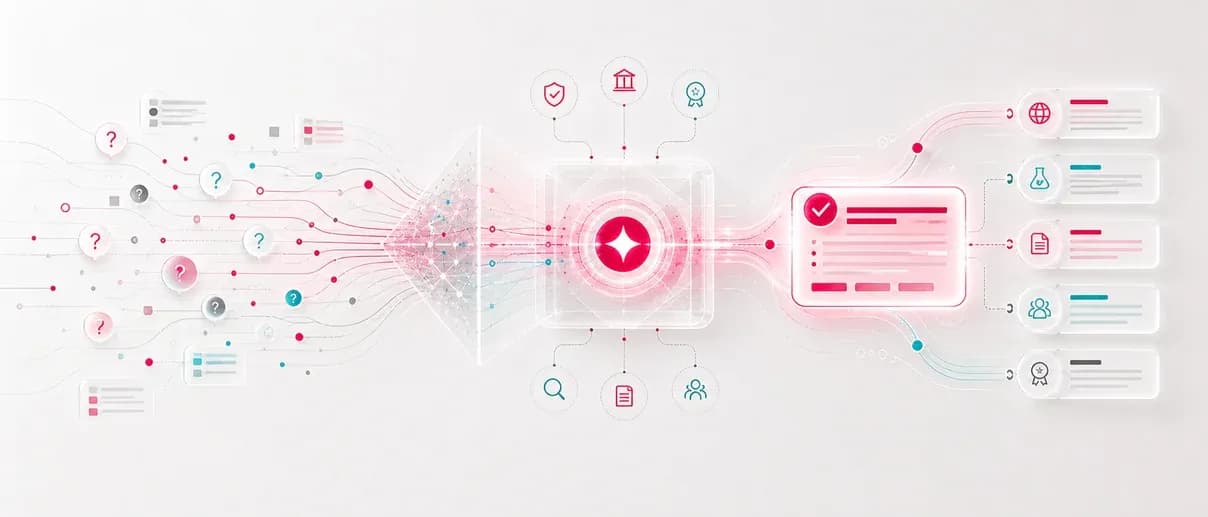
More and more people get their answer without ever clicking a search result. They ask an AI assistant, and it reads them a finished paragraph. The source of that paragraph is the new visibility.
For marketing leaders this means: ranking on page one is no longer enough. You have to be the passage a machine considers trustworthy enough to adopt verbatim. Answer engine optimization is not a new discipline next to SEO - rather its logical continuation: it is no longer only about the click, but increasingly about being quoted.
And machines quote differently than people click: not the page that advertises loudest, but the one that answers a question most clearly.
What actually helps here is pleasingly hands-on - and less mysterious than the consulting circuit currently makes it sound.
The most common reason a text is not quoted is banal: it circles the question with positioning instead of answering it. An AI looks for the passage that answers a concrete question in two or three clear sentences. Hide the answer behind marketing and you are not punished - you are simply not found. So it helps to put the answer up front and the positioning after.
Structure makes the same difference. A clear question as the heading, an answer beneath it that stands on its own, structured data for context. An FAQ section with clean schema markup is therefore one of the strongest levers of all: it hands the machine exactly the format it wants to quote - a question and a self-contained answer in one.
What many underrate: AI systems weight sources by reliability. A statement with a traceable source, clear authorship and a recognizable professional background gets picked up over the same statement without a sender. Authorship is no longer a vanity feature; it has become a ranking signal. And superlatives? The systems filter those out fairly reliably. What has to remain is the sober, correct answer.
If you want a sense of where you stand: write down the five questions your customers would ask an AI about your topic, and check whether your site has, for each one, a passage that answers exactly that question in three clear sentences - without advertising, with recognizable authorship. Wherever none exists, that is your next content task.